Mattress Materials & Sleep
Inside a Vispring Mattress: How Natural Fillings Shape Feel and Support
A mattress is not just a spring system wrapped in fabric. The layers above and around its springs help determine whether the surface feels plush or taut, how readily it yields at the shoulders and hips, and how it handles warmth and moisture. In Vispring mattresses, natural upholstery materials can be part of that story—but the recipe varies by model, and the name alone cannot tell you how a particular bed will feel.
Published October 16, 2026
Open the description of a traditionally built mattress and the vocabulary can sound almost pastoral: wool, cotton, hair, silk. But beneath the romance is a practical question. What does each material do once a sleeper settles in? A spring unit may provide the underlying response, while the upholstery above it softens contact, spreads pressure and contributes to the mattress’s thermal character. The finished feel emerges from the combination—not from any single fiber in isolation.
Vispring is associated with pocket-spring construction and natural upholstery, but its mattresses are not all made to one formula. Materials, layer order, spring arrangement, tension and surface construction may differ between models. That makes the specification sheet more useful than a broad assumption about what “a Vispring mattress” feels like. It also makes a careful comparison possible: look past the fiber names and ask how the whole construction is intended to respond.
This guide explains the roles commonly associated with wool, cotton and hair, how fillings interact with pocket springs, and what to consider when comparing mattress construction. These materials can offer distinctive qualities, but no filling guarantees a particular night’s sleep. Body shape, sleep position, room temperature, bedding and personal preference all help decide whether a mattress feels right.
The layers above the springs matter
A pocket-spring unit is a set of springs housed in individual fabric pockets. Because each spring can move with some independence from its neighbors, the system can respond locally to pressure. In broad terms, the springs form a supportive core; upholstery layers above them influence how directly or gradually the sleeper encounters that support.
Imagine two mattresses with similar spring systems but different comfort layers. One may use a relatively resilient, lightly padded surface that makes the spring response more noticeable. Another may have deeper or softer upholstery that creates a more cushioned first impression. Neither outcome can be attributed to the spring count alone. The thickness, density, arrangement and attachment of the fillings are part of the design.
There is also a distinction between surface comfort and support. A top layer can feel soft when pressed by a hand yet still sit over a supportive core. Conversely, a mattress that feels firm at first contact may not provide the right support for every body. “Firmness” is a useful description, but it is not a universal measurement; it is experienced through the interaction of the sleeper and the full mattress.
Natural upholstery should therefore be understood as a system. Fibers are layered, compressed and secured in specific ways. Their combined effect can shape cushioning and airflow, while the spring unit and mattress base influence how the bed responds beneath them.
Wool: loft, moisture management and a sense of warmth
Wool is used in bedding because its structure can hold air, adding a layer of loft and insulation. In mattress upholstery, it may contribute a cushioned, slightly yielding feel and help moderate the immediate contact between the body and the spring system. Depending on the amount, preparation and placement of the wool, that effect may be subtle or more pronounced.
Wool can also absorb moisture vapor and release it into the surrounding air. This property may help the sleep surface feel less clammy for some people, though it does not make a mattress immune to heat. Warmth is influenced by the entire bed: the sleeper, room, mattress layers, sheets, duvet and airflow around the bed all contribute. A thickly upholstered mattress can still feel warm, and a material described as breathable cannot promise cool sleep in every setting.
Compression is another part of wool’s story. Fibers can settle under repeated pressure, and mattress makers may use preparation and construction techniques to manage how the filling behaves over time. The quantity and placement of wool, and the way it is secured, are more informative than the word “wool” by itself. Ask whether the material appears in a comfort layer, deeper upholstery or several layers, and how the maker describes maintenance and expected settling.
For shoppers comparing a wool mattress or a wool-upholstered model, the key is not to treat wool as a stand-alone performance claim. It is one part of a layered construction. Its contribution depends on what surrounds it and what lies beneath it.
Cotton: a familiar fiber with a structural role
Cotton may appear in mattress upholstery, blended with other fibers or used in a cover or ticking. Its presence alone says little about the feel of the bed. A thin cotton layer is not equivalent to a substantial batting layer, and cotton blended with wool will behave differently from cotton used on its own.
In a filling blend, cotton can contribute body and a relatively stable layer. In a cover, it affects the fabric that sits closest to the sleeper. The weave and finish matter as well as the fiber: two cotton fabrics can differ in texture, air movement and durability. When a specification lists cotton, it is reasonable to ask where it is used and whether it is part of the upholstery, the ticking or both.
Care is another practical consideration. A mattress is not generally washed like a sheet, and upholstery fibers are largely enclosed. A removable cover, if present, may have its own care rules; the mattress itself may require spot treatment or routine airing rather than laundering. Follow the manufacturer’s instructions rather than assuming that a natural fiber means easy cleaning.
Cotton’s familiarity can make it sound uncomplicated, but the details matter. Fiber quality, blend, layer depth and construction all help determine what the material contributes to the finished mattress.
Hair and other resilient fibers
Hair—often described in mattress specifications as horsehair or horsetail—is valued in some traditional constructions for its springy, resilient character. Compared with a soft, compressible layer, a resilient filling may add a livelier response: it gives under pressure and tends to rebound rather than remain uniformly compressed. The actual sensation depends on the fiber preparation and the way it is layered with other materials.
That response can be part of a mattress’s overall balance. A cushioning layer may soften the first contact; a more resilient material deeper in the upholstery can help the surface recover as the sleeper moves. These roles are not fixed rules. A blend’s proportions and position can change the result, and the spring system remains an important partner.
Descriptions of hair can also be easy to overread. A material’s name does not indicate how much is present, whether it is used throughout the mattress or only in a specific layer, or how firm the mattress will feel. Nor does “natural” automatically mean superior for every sleeper. The useful questions are concrete: what is the material, where is it placed, how is the mattress constructed, and does the completed bed suit your needs?
Pocket springs and upholstery: a partnership, not a contest
It is tempting to ask whether springs or fillings matter more. The question is a little like asking whether a chair’s frame or its cushioning determines how it feels. Both contribute, and their relationship is the point. Pocket springs can respond to weight and movement beneath the surface; the upholstery changes how that response reaches the body.
Spring tension, spring layout and the construction of the border can affect the support profile and usable surface. Above that, upholstery may diffuse pressure and introduce a softer or more buoyant sensation. The result is not simply “springy” or “soft.” It can be a blend of immediate cushioning, deeper resistance and recovery when a sleeper shifts position.
Hand-tufting, where used, is a construction method that helps hold layers together and can influence the surface’s character. Side-stitching and border construction may contribute to edge stability. These details should be considered alongside the filling list, not as decorative footnotes. For a complete picture, examine the mattress’s full specification and, where possible, try the exact model on a suitable base.
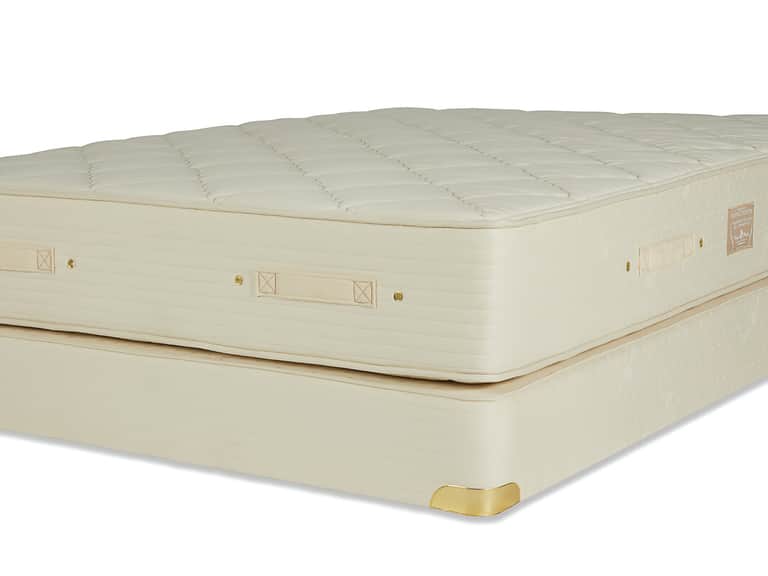
One model-specific example is the Vispring Opulence Mattress. Its listed construction describes a combination that includes wool, cotton, cashmere, alpaca, silk, bamboo and long-strand horsetail, alongside a layered pocket-spring system. That description illustrates how an individual model can combine materials with different intended roles. It should not be taken as a template for every Vispring mattress; other models may have different fillings and construction.
Why the exact model specification is essential
Brand reputation can be a useful starting point, but it cannot substitute for model-level information. A manufacturer’s range may include different firmness choices, spring configurations and upholstery combinations. Even when two models use some of the same fibers, their proportions, order and construction can change the experience.
Start by identifying the exact model name and size. Then check the current manufacturer specification or ask an authorized retailer to confirm the details. Look for the listed filling materials, their order if provided, spring type and tension options, mattress depth, and whether the design is one-sided or intended to be turned. Product descriptions can change, and names that sound similar are not proof of identical construction.
Ask what a firmness label means in practical terms. Is it a choice of spring tension, a change in upholstery, or both? Does the mattress feel different when used on a solid platform than on the recommended base? What are the care requirements? Clear answers make it easier to compare models without relying on broad claims about natural materials or craftsmanship.
It is also worth checking whether a mattress is designed to be flipped, rotated or used in only one orientation. These instructions vary, and incorrect assumptions can affect comfort and wear. The manufacturer’s guidance should take precedence over general mattress-care advice.
Match feel to sleep position and body shape
Fillings do not select themselves for a particular sleep position. A side sleeper may seek enough surface cushioning to accommodate the shoulder and hip while keeping the torso supported. A back sleeper may prioritize an even, balanced feel; a stomach sleeper may be more comfortable on a surface that does not allow the midsection to sink excessively. These are starting points, not rules that apply to everyone.
Body weight and proportions affect how a mattress compresses. Two people can lie on the same model and experience different levels of firmness because they apply pressure differently. Sleep habits matter too: someone who changes position often may notice the ease of movement and recovery, while someone who stays still may focus more on pressure comfort.
When testing, spend more than a few seconds on the mattress. Lie in your usual position, settle into the surface and notice whether pressure builds at the shoulder, hip or lower back. Try turning over. If you share the bed, consider whether movement from one side disturbs the other and whether the usable edge feels stable. A quick showroom impression is not a guarantee, but a deliberate trial can reveal more than a label.
For couples with different needs, test together and compare notes. One partner’s preferred softness may not suit the other, and a shared mattress can make trade-offs especially noticeable. Trial periods, return conditions and warranties are practical parts of the decision; read their terms before purchase.
Temperature, allergies and other practical concerns
Natural fillings are sometimes described as inherently cool, hypoallergenic or healthier. Such blanket claims deserve caution. Fiber properties can influence airflow and moisture handling, but the temperature of a sleep surface depends on the complete construction and the conditions around it. Mattress covers, protectors, sheets and duvets can alter how heat moves through the bed.
People with sensitivities should identify the specific material that concerns them and review the manufacturer’s documentation. “Natural” is a description of origin, not a guarantee that a product will suit every individual. Some people are sensitive to particular fibers, finishes or dust; others may be more concerned about cleaning and long-term care. A clinician can advise on allergy or health questions that go beyond product specifications.
Certifications, when present, also need to be interpreted precisely. A certification may relate to a material, a processing stage or a facility rather than every component of a finished mattress. Check what is certified and by whom, rather than treating a single label as proof of every environmental or health claim.
Finally, consider the mattress’s surroundings. A breathable construction cannot compensate for a poorly ventilated room, an overly warm duvet or a bed base that restricts airflow if the design requires it. Comfort is a system-level experience.
A practical checklist for comparing natural mattress fillings
Before choosing a mattress, use a short list of questions to move from appealing material names to useful information:
- Which exact model is this? Confirm the name and current specification rather than assuming the range uses one standard recipe.
- What fillings are included? Note wool, cotton, hair and any other fibers, and ask where each sits in the construction.
- What does the spring system contribute? Check the spring type, available tensions and any guidance about the matching base.
- How does the complete mattress feel? Test the actual model in your usual sleep position and allow time to settle.
- How should it be maintained? Confirm whether it should be rotated, turned or left in one orientation, and follow the stated care instructions.
- What claims are documented? Distinguish specific certifications and material disclosures from broad language such as “eco-friendly” or “naturally cooling.”
- What are the trial and warranty terms? Understand return conditions, exclusions and the support available after delivery.
This approach is useful beyond Vispring. It applies to any mattress that combines pocket springs with natural upholstery, as well as to latex and hybrid designs. The objective is not to find a universally best fiber. It is to understand the construction well enough to judge whether it suits the person who will sleep on it.
The quiet work of the filling
Natural fillings do not work like a headline feature switched on by the label. Wool may contribute loft and moisture management; cotton may appear as batting or fabric; hair can bring resilience. But a mattress is the outcome of their arrangement, the springs beneath them and the way the entire structure is built.
That is why the most reliable route through a mattress specification is both curious and cautious. Learn what each material can contribute, then verify how the individual model uses it. Compare the completed mattress by feel, support and fit—not by fiber names alone. A well-matched bed is less a triumph of one ingredient than a balance of materials, construction and the sleeper’s own needs.